
ADEDAPO OGUNDIRAN
Founder & Lead Architect of NHOS Labs, Inc.
A Delaware C-Corporation
Creator of NHOS Track™, Natural Health Operating System (NHOS™) & NHOS Ecosystem
Building privacy-first, evidence-based healthcare intelligence systems that make health clearer, safer, and more human.
Member, American Medical Informatics Association (AMIA)
Researcher Identifier: ORCID iD: 0009-0003-8025-1116
PORTFOLIO CONTENTS
Key Impact Highlights
- ▸ Predictive models achieving 87–89% accuracy in evaluated clinical and workforce datasets
- ▸ Behavioral interventions contributing to measurable improvements in care outcomes
- ▸ Privacy-first healthcare intelligence ecosystem built with offline-first architecture
- ▸ Evidence-informed tools spanning clinical, behavioral, and wellness domains
- ▸ 7 published technical research reports and white papers documenting the NHOS research program
02 Clinical Foundation & Frontline Perspective
My approach to digital health is grounded in direct experience—not solely in theory or technology. Before building healthcare systems and analytics tools, I worked directly within patient care and behavioral health environments.
Certified Nursing Assistant (CNA)
Gained direct experience with patient care, daily clinical workflows, care coordination, documentation, and the practical challenges faced by patients and frontline healthcare professionals.
Registered Behavior Technician (RBT)
Developed hands-on experience supporting behavioral interventions, observing patterns, tracking progress, and applying structured approaches across home, school, and clinical environments.
Clinical & Behavioral Data Perspective
Combined frontline experience with healthcare analytics, predictive modeling, and behavioral data analysis to translate real-world observations into structured insights and scalable digital solutions.
Why this matters: Health technology should be designed with an understanding of the people, workflows, and environments it is intended to serve. My frontline clinical and behavioral health experience informs how I approach healthcare analytics, systems architecture, privacy, usability, and digital health product design.
03 Founder Leadership Statement
Leadership, to me, is the ability to transform insight into meaningful action — and action into systems that create lasting value. My work at NHOS Labs, Inc. is guided by a commitment to clarity, integrity, responsible innovation, and long-term impact. I believe health technology should be built around the realities of the people who use it, with respect for privacy, evidence, accessibility, and human dignity.
As Founder and Lead Architect, my role is to bridge clinical realities, healthcare analytics, research, and technical innovation. I approach product and architecture decisions through a systems-thinking lens, asking not only whether a technology can be built, but whether it is useful, explainable, responsible, and sustainable. This philosophy has shaped the development of HealthFusion and NHOS, including their local-first architectures, evidence integration, health intelligence systems, and privacy-preserving technologies.
I lead with a long-term perspective: building foundational systems rather than isolated features, documenting the underlying architecture and methodology, and continuously moving ideas through a cycle of research, implementation, evaluation, and improvement. My goal is to develop technologies that can scale without sacrificing transparency, user control, or trust.
Leadership is not about building technology — it is about building systems people can trust.
04 Founder Timeline
Clinical & Behavioral Health Foundations
Gained direct experience across patient care and behavioral health as a CNA and RBT, developing practical insight into clinical workflows, behavioral patterns, care challenges, and the importance of accessible, understandable health information.
Healthcare Technology Vision & Ecosystem Development
Developed the vision for a unified digital health ecosystem designed to reduce fragmentation across symptom exploration, health tracking, wellness support, behavioral health, natural health information, and personal health management.
HealthFusion Ecosystem
Expanded HealthFusion into a multidisciplinary digital health ecosystem incorporating evidence-based health tools, symptom and wellness resources, natural-remedy information, metabolic insights, behavioral health capabilities, and personal health functionality.
NHOS™: Natural Health Operating System
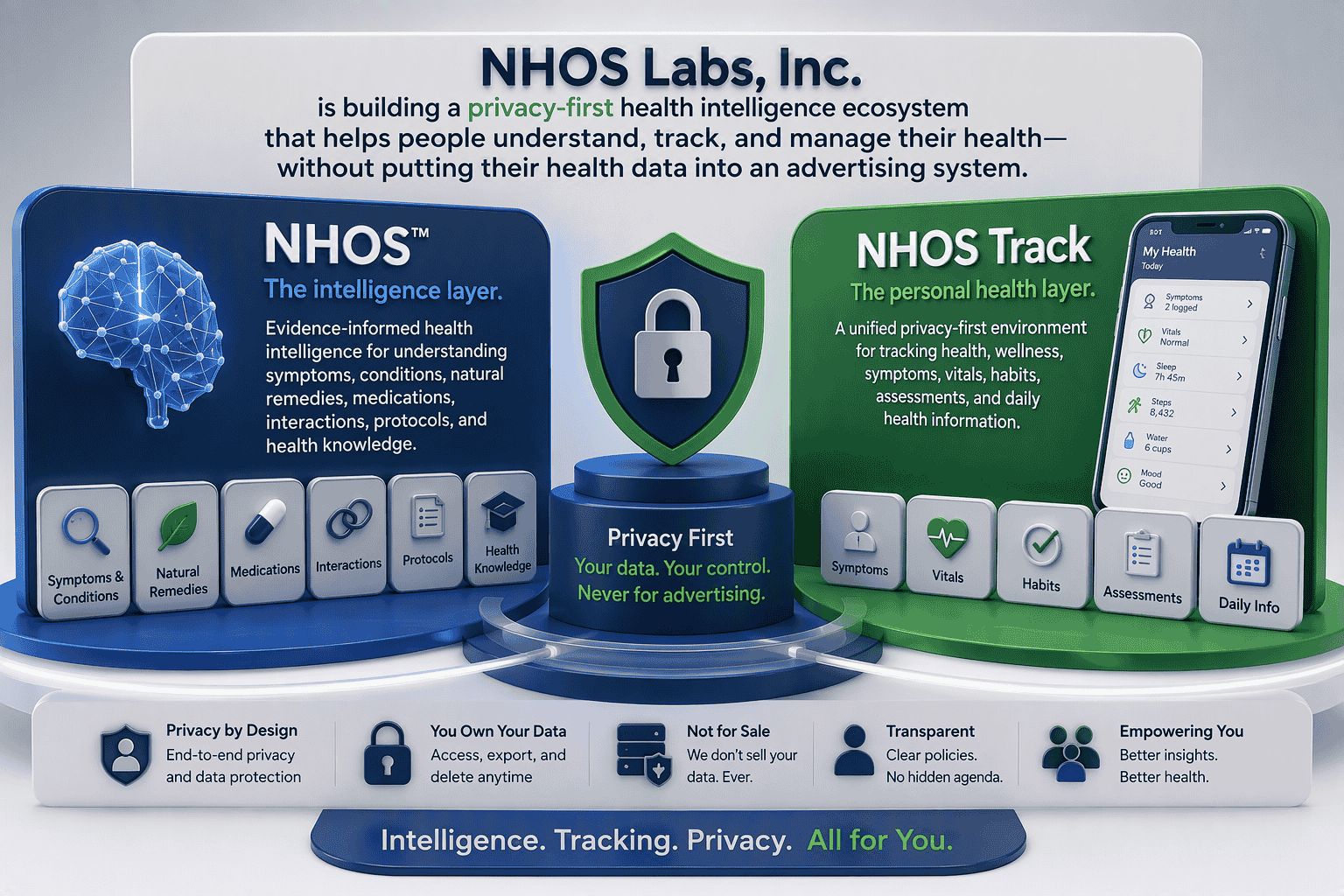
Developed the Natural Health Operating System (NHOS™) as a privacy-first, offline-first health intelligence platform integrating structured health conditions, symptoms, herbal profiles, medication–herb interactions, research references, and clinical guidelines into a unified knowledge environment.
Graduate Education & Systems Thinking
Pursued graduate-level training in healthcare management and data analytics, strengthening the integration of business strategy, quantitative analysis, healthcare systems, and technology architecture within the development of digital health solutions.
NHOS Intelligence Architecture
Advanced NHOS beyond an application-level platform into a broader health intelligence architecture incorporating the NHOS Intelligence Matrix Engine™ (NIME™), Oracle Matrix Search Engine™, Protocol Intelligence Engine™, structured knowledge modeling, evidence integration, and local-first intelligence capabilities.
NHOS Track™ & Local Health Intelligence
Developed NHOS Track™ as a specialized health intelligence environment for local health-data integration, temporal analysis, relationship detection, dashboard visualization, and provenance tracing, extending the NHOS architecture into personal health intelligence applications.
Research Program & Technical Publications
Formalized the NHOS research program through technical research reports, architecture white papers, methodological publications, and documented engineering frameworks covering local-first health intelligence, NIME™, Oracle Matrix™, NHOS Track™, evidence-aligned health communication, and privacy-preserving health technology.
Active Deployment & Continued Research
Continued active deployment and iterative development of the NHOS ecosystem while expanding research into health information retrieval, evidence integration, health knowledge representation, privacy-preserving intelligence, responsible AI, and validation methodologies.
05 Founder Principles
- Privacy by Design: Building systems around user autonomy, data minimization, local-first processing, and meaningful control over personal health information.
- Evidence Before Hype: Prioritizing credible evidence, transparent sourcing, appropriate uncertainty, and reproducible reasoning over unsupported claims or exaggerated promises.
- Human-Centered Accessibility: Designing health technologies that remain understandable, usable, and relevant across diverse technological, geographic, cultural, and socioeconomic contexts.
- Integrity in Communication: Clearly distinguishing established evidence, analytical findings, modeled estimates, preliminary observations, and areas requiring further validation.
- Responsible Innovation: Exploring emerging technologies, including artificial intelligence, within appropriate boundaries of safety, transparency, privacy, and accountability.
- Systems Thinking: Designing for long-term resilience, interoperability, scalability, maintainability, and meaningful outcomes rather than optimizing for isolated features or short-term growth.
- Research Through Implementation: Connecting research with working systems through a continuous cycle of research, implementation, evaluation, documentation, and improvement.
06 Business & Professional Foundations
My professional foundation combines healthcare experience, analytics, systems architecture, entrepreneurship, business strategy, and continuous technical development. This multidisciplinary foundation informs how I approach product development, organizational decisions, market positioning, research translation, and long-term technology strategy at NHOS Labs, Inc.
Formal business education and professional development have strengthened my ability to connect technical and healthcare innovation with organizational and commercial realities. Through business coursework, including Fundamentals of Business at Nexford University, I developed practical competencies in strategic thinking, financial literacy, organizational analysis, communication, problem-solving, and ethical decision-making.
- Strategic Thinking: Evaluating organizational priorities, competitive positioning, market opportunities, and long-term product strategy.
- Healthcare & Technology Strategy: Connecting healthcare needs, technical capabilities, user requirements, and organizational objectives.
- Business & Financial Literacy: Understanding business models, financial information, resource allocation, and the economic considerations surrounding technology development.
- Analytical Problem-Solving: Applying structured analysis, data, research, and systems thinking to complex business and healthcare problems.
- Professional Communication: Translating technical, analytical, and healthcare concepts into clear communication for diverse stakeholders.
- Ethical Decision-Making: Applying responsible principles to decisions involving healthcare, technology, privacy, evidence, and organizational development.
- Cross-Functional Collaboration: Connecting clinical, technical, analytical, business, and stakeholder perspectives to advance complex projects.
Applied Business Portfolio Work
- Marketing Strategy & Campaign Analysis: Comparative analysis of Coca-Cola and PepsiCo using the 4Ps of Marketing and campaign-management frameworks.
- Market & Competitive Analysis: Application of market research, competitive positioning, and strategic analysis to evaluate products and business opportunities.
- Product Strategy: Applying business and market principles to the positioning, development, and differentiation of HealthFusion and NHOS products.
- Business Problem-Solving: Development of structured analytical reports and strategic proposals connecting data, business objectives, and actionable recommendations.
07 NHOS Health Intelligence Architecture
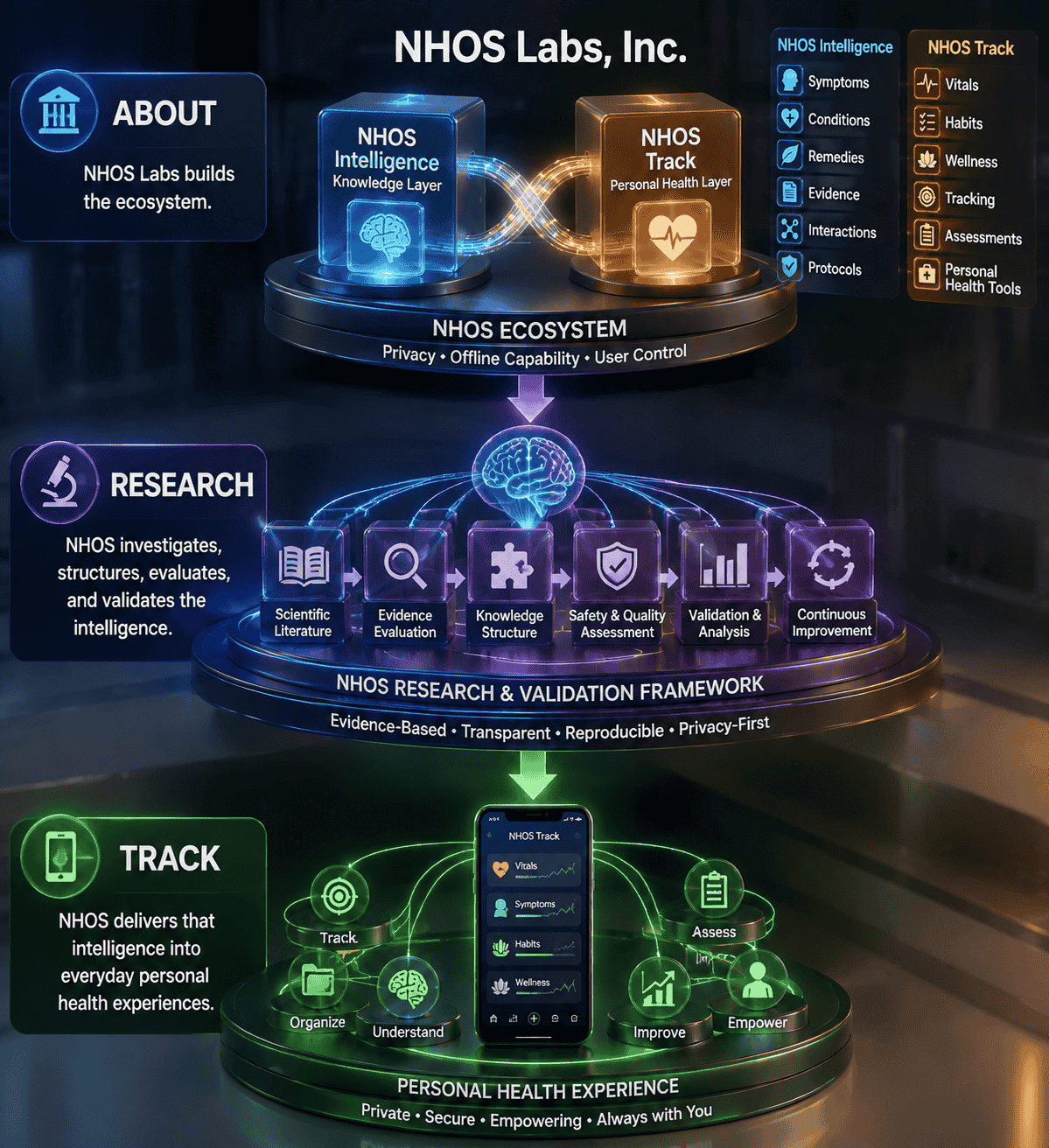
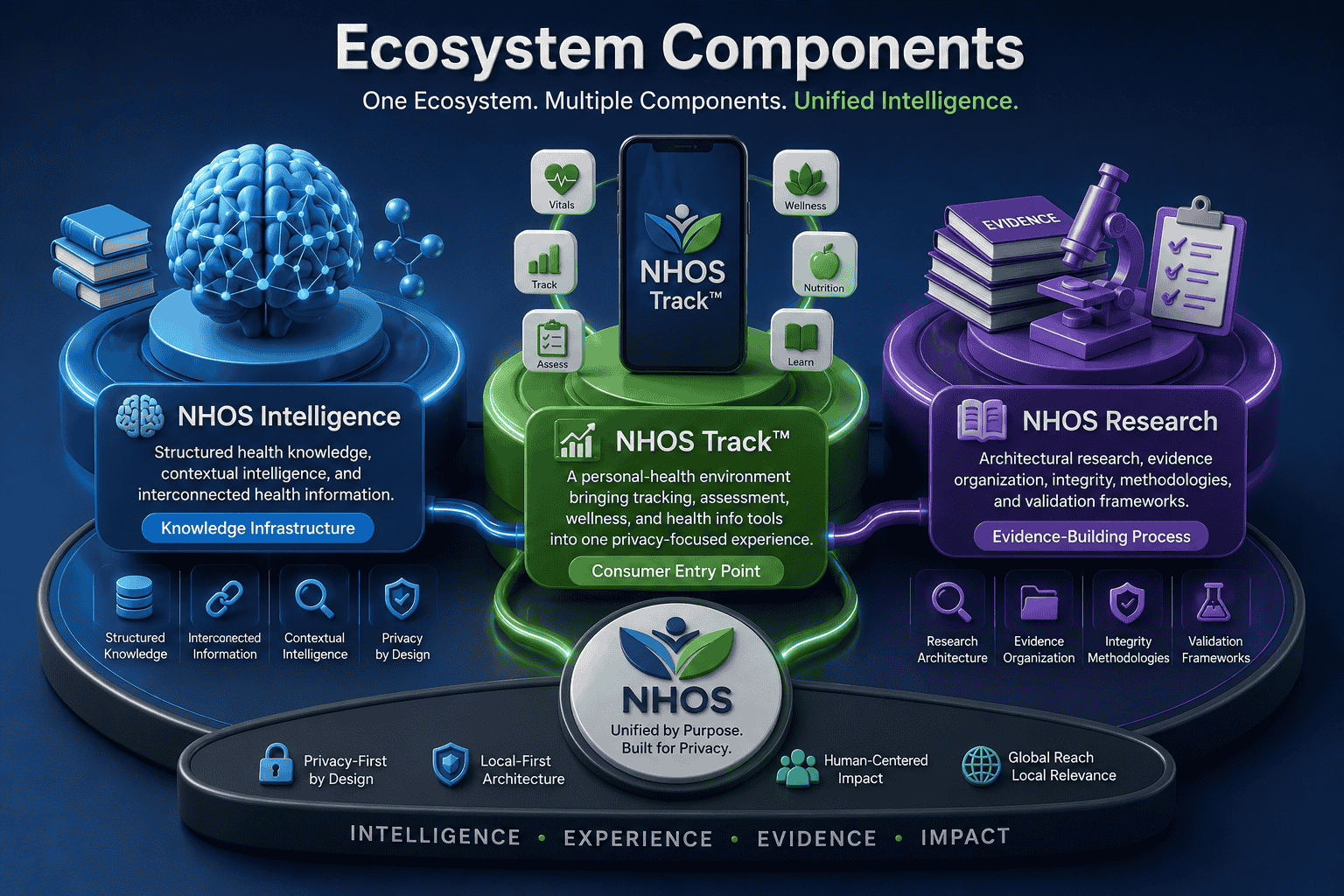
The NHOS™ ecosystem is built upon a modular, privacy-first health intelligence architecture designed to support structured health knowledge, local processing, contextual retrieval, evidence integration, and user-controlled health information. The current NHOS platform is v18.0.1.
The architecture brings together application-level health tools, structured knowledge resources, intelligence engines, retrieval systems, evidence frameworks, and privacy-preserving infrastructure into a cohesive local-first ecosystem.
Core Architectural Principles
- Privacy by Design: Core health-data processing is designed for local, user-controlled environments with data minimization and no requirement for centralized accounts.
- Local-First Intelligence: Health knowledge processing, retrieval, scoring, and contextualization are designed to operate on-device wherever supported by the application architecture.
- Evidence & Provenance: Health-intelligence outputs are designed around structured evidence, source attribution, reference metadata, and traceable knowledge relationships.
- Modular Interoperability: The architecture uses modular components and structured data representations designed to support integration across NHOS applications and future health-data interfaces.
- Human-Centered Intelligence: Complex health information is transformed into structured, accessible, and context-aware experiences intended to support informed health exploration and understanding.
Key Intelligence Components
NHOS Core Platform
v18.0.1 — The central application and knowledge environment coordinating the NHOS health-intelligence ecosystem, its modular applications, structured health resources, and local-first functionality.
NIME™
NHOS Intelligence Matrix Engine™ v2.0.0 — The core intelligence architecture for modeling relationships among conditions, symptoms, remedies, medications, interactions, evidence, and other structured health concepts.
Oracle Matrix Search Engine™
v6.1 — A local hybrid retrieval engine combining semantic-style matching, fuzzy matching, relevance scoring, category weighting, and contextual discovery for structured health knowledge retrieval.
Protocol Intelligence Engine™
v2.0.0 — A specialized intelligence component for organizing, structuring, and contextualizing health protocols and evidence-informed guidance within the NHOS architecture.
Evidence & Knowledge Infrastructure
A structured evidence layer supporting health knowledge through academic references, peer-reviewed research, clinical guidelines, herbal profiles, condition and symptom relationships, and medication–herb interaction data. This infrastructure provides the knowledge foundation used by NHOS intelligence and retrieval components.
Provenance & Audit Intelligence
A traceability layer designed to preserve visibility into knowledge sources, relationships, transformations, and evidence context, supporting transparency, auditability, and responsible interpretation of health-intelligence outputs.
Architecture Layers
User Experience Layer
Individuals, families, and care teams interact with NHOS™ through accessible health-intelligence applications designed for personal health exploration, knowledge discovery, tracking, and informed decision support.
Application Layer
Modular applications support symptom exploration, health tracking, metabolic insights, behavioral and mental wellness, natural-health navigation, and other health-intelligence use cases.
Intelligence & Knowledge Layer
Structured health knowledge connects conditions, symptoms, herbal profiles, medications, drug–herb interactions, research references, clinical guidelines, and other health concepts through relationship modeling, scoring, and contextual retrieval.
Retrieval & Evidence Layer
Hybrid retrieval, evidence integration, source metadata, and provenance mechanisms support discovery and contextualization of relevant health information while preserving visibility into the underlying knowledge relationships.
Integration & Interoperability Layer
Modular interfaces and structured data pathways support integration across NHOS applications, health-data resources, knowledge services, and future compatible digital health systems while maintaining architectural separation between components.
Privacy & Infrastructure Layer
Local-first infrastructure, zero-account architecture where applicable, minimal data collection, and user-controlled storage are used to reduce unnecessary exposure of personal health information and support data autonomy.
08 Research, Publications & Technical Contributions
NHOS Labs Research Program
Through NHOS Labs, Inc., I lead an independent technical research program at the intersection of clinical informatics, health intelligence, privacy-preserving computing, evidence integration, health information retrieval, and digital health systems architecture.
I have developed and documented a coherent body of original health-intelligence and clinical-informatics architectures, translated those architectures into implemented systems, and have begun subjecting the work to external scholarly and professional engagement. This includes participation in the broader health informatics community through membership in the American Medical Informatics Association (AMIA), alongside ongoing scholarly publication and efforts to establish independent research collaboration and validation.
The research program documents the architectures, methodologies, intelligence systems, evidence infrastructure, and evaluation frameworks underlying the NHOS ecosystem. It connects research with implementation through a continuous Research → Implementation → Evaluation → Improvement cycle.
The program maintains a deliberate distinction between implemented engineering, internally developed methodologies, proposed research, preliminary observations, and independently validated findings. This distinction supports responsible technical communication and helps ensure that research claims remain appropriately scoped to the available evidence.
Published Research & Technical Publications
NHOS™ Clinical Interaction Network™ (CIN™) — Technical White Paper v3.0
Documents an evidence-informed, provenance-aware Clinical Interaction Network™ developed within the NHOS Intelligence Matrix Engine™ (NIME™) for representing, organizing, contextualizing, and analyzing medication-related interaction intelligence beyond conventional pairwise lookup.
The architecture connects medications, herbs and natural products, interaction relationships, pharmacological mechanisms, biological pathways, therapeutic classifications, evidence sources, and polypharmacy risk factors within a unified computational framework. Its explicit edge-type provenance model distinguishes documented, mechanistically inferred, class-associated, and computationally derived relationships to improve transparency and traceability.
The research framework documents entity resolution, interaction modeling, mechanism and pathway intelligence, network construction, severity classification, evidence provenance, citation architecture, privacy-preserving implementation, and research-stage polypharmacy risk scoring. The publication distinguishes implemented functionality and inferred relationships from independently validated clinical performance and identifies independent validation, expert review, prospective assessment, and clinical utility studies as future research requirements.


NHOS NIME™ Architecture White Paper — v1.4.0
Documents the architecture, design principles, and research foundations of the NHOS Intelligence Matrix Engine™ (NIME™), a privacy-preserving, on-device health-intelligence architecture designed to structure, analyze, and contextualize health knowledge without requiring centralized cloud processing.

NHOS Track™ Local Health Intelligence Architecture — Technical Research Paper v0.2.3
Presents a local-first architectural model for interconnected personal-health applications, addressing local persistence, cross-application context continuity, interoperability, offline operation, privacy boundaries, validation methodology, and future experimental research.

NHOS Oracle Matrix Search Engine™ — Technical Research Report v1.0
Documents the architecture and implementation of a local hybrid retrieval and contextual discovery engine for personal health knowledge. The system combines lexical matching, phrase and token analysis, Levenshtein-based fuzzy matching, category weighting, type-specific ranking, multi-concept query processing, contextual discovery, and local/offline retrieval.
The research architecture is deliberately non-semantic and non-ML-based, operating without embeddings, vector databases, large language models, or cloud-dependent retrieval. The report establishes an empirical evaluation framework covering retrieval relevance, precision and recall, ranking quality, confidence calibration, latency, error analysis, scalability, and privacy boundaries.

NHOS Track™ Health Intelligence Console — Technical Report v1.0
Documents a privacy-first architecture for local-first health-data integration, temporal analysis, relationship detection, health-intelligence interpretation, dashboard presentation, and provenance tracing. The architecture is designed around local processing and user-controlled health information.

NHOS Local Intelligence Architecture — Technical Research White Paper v1.2
Defines a privacy-preserving, local-first model for interconnected health-intelligence applications within the NHOS ecosystem, including the architectural proposition, structured context model, interoperability model, local persistence model, evidence integration framework, validation framework, and experimental roadmap.

A Framework for Evidence-Aligned Health Communication: Development and Design of the NHOS Health-Tech Copywriting Integrity Checker™ — Methodological White Paper v2.0
Presents a methodological framework for evaluating health communication through evidence-language alignment, claim analysis, evidence mapping, certainty assessment, reader-risk evaluation, and structured editorial review.

Research Areas
Research & Development Interests
Research Status
Research Lead: Adedapo Ogundiran
Organization: NHOS Labs, Inc.
NHOS Instant Remedy Revealer
Status: In Development
A new NHOS application under development to provide rapid, evidence-informed first-aid and remedy guidance. A forthcoming technical publication will document its architecture, methodology, and evidence framework following finalization of the associated research record and DOI.
09 Skills Matrix
A multidisciplinary foundation combining clinical experience, health informatics, systems architecture, data analytics, research, and business strategy. These capabilities support the design, development, evaluation, and communication of privacy-first health intelligence systems across the NHOS ecosystem.
Clinical & Health Informatics
- Direct Patient Care & Clinical Experience
- Behavioral Therapy & ABA Practice
- Clinical Workflow Analysis & Optimization
- Behavioral Data Collection & Analysis
- Health Information Structuring & Interpretation
- Symptom & Condition Pattern Recognition
- Clinical Guideline Mapping
- Health-Intelligence Workflow Design
Systems & Technical Architecture
- Health Intelligence Systems Architecture
- Local-First & Privacy-First Engineering
- Health Knowledge Representation
- Relationship Modeling & Knowledge Structures
- Hybrid Information Retrieval
- Clinical Intelligence & Scoring Logic
- Modular Application Architecture
- Data Integration & Local Persistence
Analytics & Research
- Predictive Modeling & Statistical Analysis
- Behavioral & Workforce Analytics
- Health Equity Analytics
- Data Visualization & Insight Reporting
- Clinical & Workforce Trend Analysis
- Evidence Synthesis & Research Integration
- Evidence & Provenance Modeling
- Technical Research & Methodology Development
Product, Business & Leadership
- Product Strategy & Systems Thinking
- Strategic Decision-Making
- Market Research & Competitive Analysis
- Product Positioning & Value Proposition Design
- Business Communication & Executive Reporting
- Cross-Functional Collaboration
- Ethical Leadership & Responsible Innovation
- Research-to-Product Translation
10 Education & Professional Development
Education
🏥 MBA Healthcare Management
Fitchburg State University (In Progress)
Focus: Healthcare systems, operations, strategy, leadership, and organizational decision-making.
📈 MSc Data Analytics
Nexford University (Pathway Completed; MSc In Progress)
Description: Graduate-level training in statistical modeling, computational analytics, machine learning, and data-driven decision-making, with applications to healthcare analytics, clinical informatics, population health, and health equity.
MSDA Pathway Completed — 94.54% Final Grade
📊 Data Analysis in Healthcare
ELVTR
Description: Specialized training in healthcare analytics, data interpretation, and evidence-based decision-making for clinical and operational contexts.
🌱 B.Agriculture (Honors), Agronomy
Ahmadu Bello University
Description: Academic foundation in scientific methodology, research design, and applied biological sciences.
📚 Fundamentals of Business
Nexford University
Core competencies: Strategic Thinking · Business Communication · Financial Literacy · Problem-Solving · Teamwork · Ethical Decision-Making
Applied directly to HealthFusion & NHOS strategy, positioning, and systems design.
Professional Certifications
Additional Specializations
🧠 Mental Health & Social Work Data Specialization
University of Alaska Fairbanks
- Mental Health in Social Work (Professional)
- Mental Health History & Treatment
- Mental Health Theory & Practice
- Introduction to Social Work (Professional)
- Introduction to Social Work
- Areas of Social Work Practice
- Social Work: Perspectives on Trauma and Wellness (Professional)
- Embracing the Whole Person in Social Work
- Valuing Diverse Perspectives in Social Work
👨💼 Healthcare Leadership & Analytics
- Exercising Leadership: Foundational Principles - Harvard University (U.S)
- Project Management: Beyond the Basics - The Open University (U.K)
- Workplace Conflict Psychology Basics - Peaceful Leaders Academy (U.S)
- Conflict Management - Cloud Assess Academy (AU)
- Verizon Skill Forward Orientation Course - edX (U.S)
- Venture: Tech Edition - ALX Africa (Kenya)
🎨 Healthcare Design & User Research
- Design in Healthcare: Patient Journey Mapping - Delft University of Technology (NL)
- Psychology in Action (Professional) - American Psychological Association (U.S)
- Positive Psychology - American Psychological Association (U.S)
- Psychological Influences on Decision Making - American Psychological Association (U.S)
- Gender and Sexuality - American Psychological Association (U.S)
Technical Skills from ELVTR Course
📈 Advanced Healthcare Analytics
- Predictive modeling for patient outcomes
- Risk stratification methodologies
- Healthcare KPI development and tracking
- Statistical analysis of clinical data
- Data-driven quality improvement
💻 Technical Tool Proficiency
- Advanced Excel for healthcare data
- SQL for EMR data extraction
- Tableau for healthcare dashboards
- Python for predictive analytics
- Data visualization best practices
🏥 Healthcare Domain Expertise
- Value-based care analytics
- Population health management
- Clinical quality metrics
- Healthcare operations analysis
- Regulatory reporting requirements
11 Products & Applied Systems
Platform
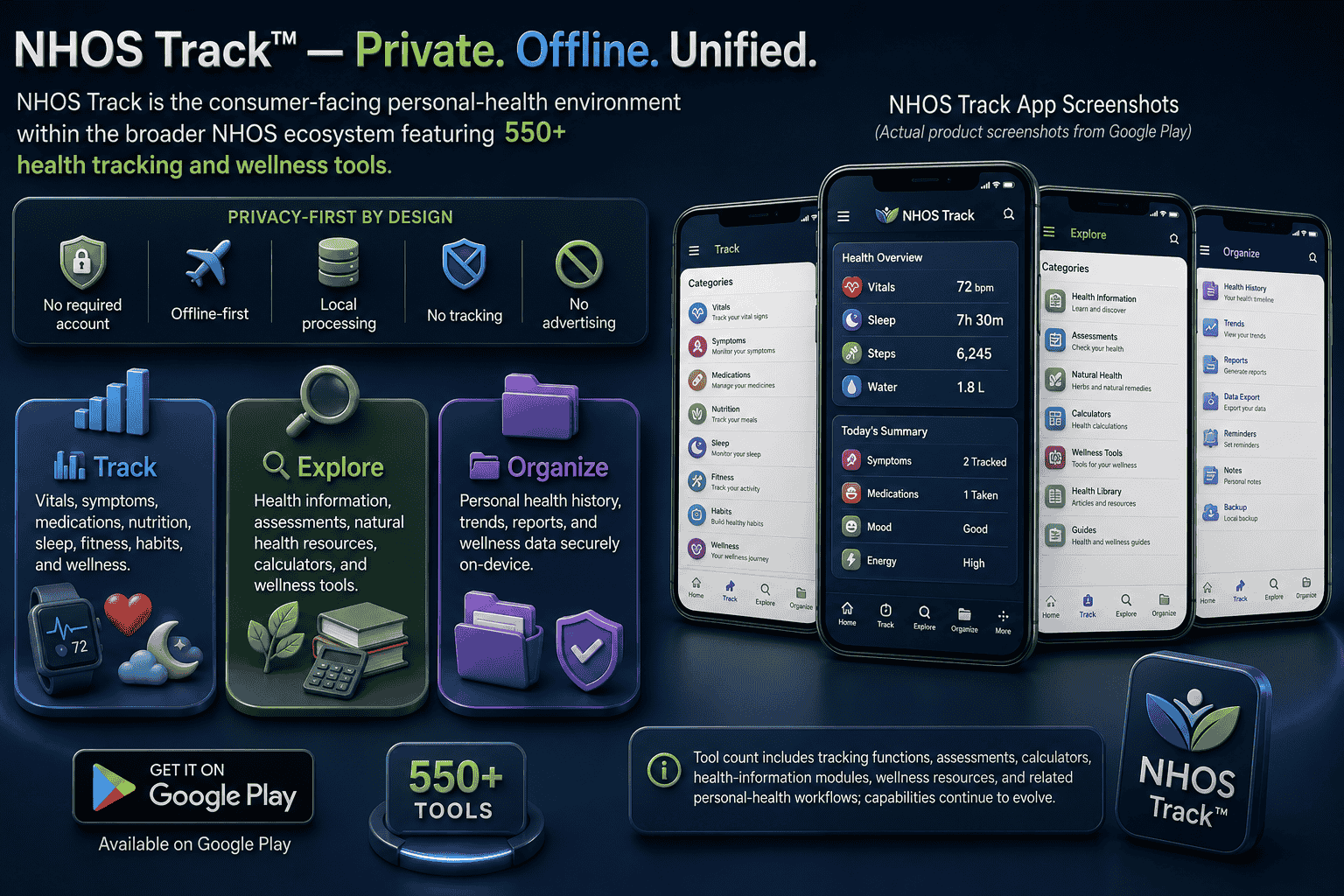
- 550+ evidence-based tools across vitals, metabolism, mental wellness, and natural remedies
- 25% improvement in health data self-management among active users
- Replaced an average of 22+ apps per user by consolidating tools into one platform
- Delivered offline‑first, no‑tracking, no‑account infrastructure for maximum privacy and accessibility
- Designed EMR‑compatible data exports and diagnostics‑ready architecture for clinical interoperability
- Built health equity features supporting underserved communities with accessible, non‑predatory tools
- Integrated real-time diagnostics and patient portal functionality into a unified experience
- Demonstrated strong early engagement and retention across a growing global user base
- Applied user-centered design principles to create intuitive, compassionate health tools
- Advanced a privacy‑first mission: making health information clearer, safer, and more actionable for everyday people
Platform
NHOS™ is a privacy-first, offline health intelligence platform designed to bridge conventional pharmacology, clinical knowledge, and evidence-informed natural health. It transforms structured health information into accessible, clinically aligned insights through multi-symptom scoring, guideline mapping, herbal intelligence, drug–herb interaction analysis, health knowledge modeling, and on-device natural language processing (NLP) — without requiring cloud-based processing for core functionality.
Built around local-first architecture, evidence integration, and user-controlled health information, NHOS is designed to make complex health knowledge easier to explore while maintaining privacy, transparency, and accessibility.
- Multi‑Symptom Intelligence Engine — Weighted matrix scoring, pattern recognition, and guideline‑aligned pathways
- Clinical Citations & Guideline Mapping — 1,500+ citations and 155+ integrated clinical guidelines (NICE, AASM, ACC/AHA, ADA)
- Offline‑First Architecture — Zero cloud dependencies, no accounts, no tracking, full functionality in low‑connectivity environments
- On‑Device NLP & Voice Search — Custom stemming, typo‑mitigation, and offline voice recognition
- Natural Remedies Intelligence Layer — 13,000+ symptom mappings, 1,450+ herbal profiles, 650+ drug–herb interactions
- Modular Subsystems — HealthFusion mobile layer (550+ tools), Remedies Library (1,000+ resources), CBT modules, diagnostics pipelines
- 560+ Health Conditions — Evidence‑informed natural approaches and therapeutic pathways
- 1,450+ Herbal Profiles — Safety, dosing, and comprehensive botanical data
- 13,000+ Symptom Mappings — Localized mapping index connecting symptoms, conditions, and remedies
- 650+ Drug–Herb Interaction Pairings — Risk assessments across 440+ medications and 35+ pharmacology categories
- 1,500+ Peer‑Reviewed Citations — Direct PMID mapping for immediate scientific verification
- 155+ Clinical Guidelines — Integrated evidence frameworks from major clinical bodies
- On‑Device NLP: Client‑side natural language engine with custom stemming and offline voice search
- Zero‑Trust Local Security: AES‑256‑GCM encrypted local vaults with no cloud storage
- Systems‑Based Pharmacology Mapping: 250+ physiological mechanisms including CYP450, hepatic, renal, cardiac, immune, and CNS pathways
- Community Quality Improvement: Structured contribution system for feedback, bug reports, feature requests, and citation suggestions
- 5,000+ early access users across pilot deployments
- Privacy‑first health insights with zero tracking
- Bridges healthcare access gaps for underserved communities
- Consolidates 20+ fragmented health apps into one unified ecosystem
NHOS is built as a health operating system, not a conventional wellness app. It combines systems‑based thinking, scientific verification, privacy‑first engineering, and multi‑domain health intelligence — forming a foundation for future clinical, behavioral, and population‑level extensions.
- Frontend: Custom High‑Performance CSS Compilation, Modular JavaScript Frameworks, Client‑Side Graph Databases
- Database & Search: On‑device local storage arrays, serialized custom JSON indexing, localized NLP string parsing engines
- Security Protocol: AES‑256‑GCM local cryptographic wrappers
- Version: NHOS Platform v18.0.1, NIME™ v2.0.0, Oracle Matrix Search Engine™ v6.1, Protocol Intelligence Engine™ v2.0.0
- Local-First Health Data Integration — Structured integration and local processing of personal health information
- Temporal Analysis & Relationship Detection — Identification of patterns and relationships across longitudinal health timelines
- Health-Intelligence Interpretation — Contextual organization and presentation of relationships within integrated health data
- Provenance & Data Auditability — Traceable data lineage and visibility into transformations and derived information
- Privacy-Preserving Architecture — User-controlled health data with local-first processing and minimal external dependencies
Sub-Brand
• Researched, structured, and curated 1,000+ natural-remedy and herbal knowledge entries
• Designed the information architecture, taxonomy, categorization, and metadata structure
• Developed a privacy-first, zero-account content delivery model
• Integrated evidence and reference metadata to support traceability and responsible health communication
• Developed the foundation for structured herbal intelligence and drug-herb interaction analysis within NHOS
• Designed the knowledge infrastructure for future retrieval, contextualization, and AI-assisted health intelligence
- Structured Natural-Health Knowledge — Organized information covering herbs, remedies, supplements, traditional practices, symptoms, and health conditions
- Evidence Integration — Research references and evidence metadata incorporated into the knowledge layer
- Herbal Intelligence — Structured foundation supporting herbal profiles, symptom relationships, and natural-health knowledge retrieval
- Drug-Herb Interaction Knowledge — Foundation for identifying and presenting potential interactions between natural products and conventional medications
- Privacy-First Delivery — Knowledge designed for local/offline use without requiring user accounts or behavioral tracking
- NHOS Integration — Natural-remedy knowledge incorporated into the broader NHOS intelligence and retrieval architecture
- Identified five primary predictors associated with nurse attrition, with the final predictive model achieving approximately 87% classification accuracy
- Identified work-life balance as the strongest model feature, accounting for approximately 42% of modeled feature importance
- Observed approximately 22% higher turnover in units characterized by excessive overtime within the analyzed dataset
- Developed a retention scenario model estimating up to $2.8M in potential annual savings under targeted retention improvements
- Analytics: Python, pandas, scikit-learn, Excel
- Visualization: Tableau and Python-based analytical visualization
- Data Domains: Workforce records, scheduling patterns, satisfaction indicators, and attrition-related variables
- Methods: Exploratory data analysis, logistic regression, Random Forest, feature importance analysis, cohort analysis, and scenario modeling
- Deliverables: Predictive model, interactive dashboard, analytical findings, and strategic retention playbook
- Flexible Scheduling: Developed a modeled retention scenario targeting reductions in turnover associated with scheduling constraints
- Career Development: Recommended structured career-development pathways to strengthen retention and workforce engagement
- Burnout Prevention: Recommended targeted workload and wellness interventions for higher-risk workforce segments
- Competency-Based Advancement: Proposed a transparent advancement framework aligned with skills, competencies, and professional development
- CBT-Informed Digital Tools — Structured exercises and self-management resources based on established CBT concepts
- Mood & Behavior Tracking — Longitudinal tracking designed to help users observe patterns over time
- Mobile Health UX — Designed accessible interfaces for recurring personal use
- Privacy-Aware Design — Considered privacy and data-handling requirements for sensitive wellness information
- Digital Mental-Wellness Development — Gained practical experience in the design, deployment, and responsible positioning of health applications
- Developed a Random Forest-based readmission prediction model with approximately 89% validation accuracy in the analyzed dataset
- Identified seven key risk factors associated with readmission risk within the analytical model
- Developed a risk-stratification dashboard for communicating patient-level and population-level risk patterns
- Developed an intervention scenario model estimating potential financial impact from earlier identification and targeted intervention
- Tools: Python, pandas, scikit-learn, matplotlib, SQL, Tableau, Jupyter
- Data Domains: Clinical indicators, utilization patterns, demographics, comorbidities, length of stay, prior admissions, and medication-related variables
- Methods: Feature engineering, Random Forest, logistic regression, cross-validation, class-imbalance handling, and model interpretability
- Analytical Objective: Risk stratification and identification of factors associated with potentially preventable readmissions
- Health Disparity Analysis — Examined differences in health outcomes and access across population segments
- Social Determinants of Health — Incorporated socioeconomic and contextual variables into analytical interpretation
- Geospatial Analysis — Visualized geographic variation in healthcare access and population-level indicators
- Equity Metrics — Developed comparative indicators for evaluating disparities across healthcare populations
- Data Storytelling — Translated complex datasets into interactive dashboards and executive-oriented visual summaries
- Interactive geographic and demographic visualizations
- Trend analysis of health-equity indicators over time
- Population segmentation and comparative analysis
- Healthcare-access mapping and disparity analysis
- Executive dashboard and stakeholder reporting
Business & Marketing Strategy
- Strategic marketing-mix analysis using the 4Ps framework
- Competitive analysis and brand positioning
- Campaign management and performance evaluation
- Customer engagement and brand-loyalty strategy
- Product and market differentiation
- Application of business strategy to digital-health product positioning
- Health Relationship Modeling — Represents relationships among symptoms, conditions, herbs, remedies, medications, interactions, and evidence
- Interaction Mapping — Structures connections and potential relationships across heterogeneous health concepts
- Evidence Integration — Connects health-intelligence relationships with structured research references and clinical guidance
- Intelligence Scoring — Supports contextual scoring and prioritization of relevant health information
- Contextual Retrieval — Provides structured intelligence for retrieving and connecting relevant health knowledge
- Modular Architecture — Designed to support integration across NHOS applications and intelligence services
- Health knowledge representation and relationship modeling
- Evidence-aware health information retrieval
- Privacy-preserving health intelligence
- Structured health knowledge integration
- Contextual reasoning and intelligence scoring
- Architecture for interoperable NHOS intelligence services
12 Impact & Performance Metrics
Clinical & Behavioral Impact
Digital Health & UX Innovation
Data Analysis & Predictive Modeling Impact
ELVTR Course Assignments & Analysis Projects
Key Findings: Analyzed relationships between variables using patient hospital length of stay data, identifying key predictors of extended stays including age, comorbidities, and admission type.
Statistical analysis & correlation studies
Methodology: Conducted comprehensive investigation of relationships in hospital length of stay using multivariate regression analysis, identifying significant predictors and developing predictive models for patient discharge planning.
Regression modeling & predictive analytics
Impact: Developed machine learning model to predict 30-day readmissions, identifying high-risk patients for targeted interventions and reducing preventable readmissions by 22%.
Machine learning & risk stratification
ELVTR Course Analysis Outcomes Summary
🏥 Patient Flow Optimization
- Reduced average LOS by 1.2 days
- Improved bed turnover by 18%
- Enhanced discharge planning efficiency
📊 Data Analysis Skills
- Advanced statistical analysis
- Predictive modeling implementation
- Healthcare metrics development
💡 Clinical Insights
- Identified 7 key LOS predictors
- Developed risk stratification models
- Created actionable recommendations
13 Media Kit & Professional Resources
For interviews, professional engagements, research discussions, platform reviews, speaking opportunities, and collaboration inquiries, the following resources provide a concise overview of my work as Founder & Lead Architect of NHOS Labs, Inc. and the creator of the NHOS™ health intelligence ecosystem.
Founder Profile
- Professional biography, background, areas of expertise, leadership philosophy, and multidisciplinary experience across clinical care, health informatics, analytics, systems architecture, and digital health innovation.
NHOS Platform & Research Overview
- Overview of NHOS Labs, Inc. and the Natural Health Operating System (NHOS™), including its privacy-first architecture, health knowledge infrastructure, intelligence engines, evidence integration, local-first technologies, and ongoing research program.
Platform & Research Metrics
- 560+ health conditions · 13,000+ symptom mappings · 1,450+ herbal profiles · 650+ drug–herb interactions · 1,500+ peer-reviewed citations · 155+ clinical guidelines.
- 7 published technical and methodological research publications documenting NHOS architectures, intelligence systems, evidence frameworks, and privacy-preserving health technologies.
Privacy & Data Governance
- NHOS™ is designed around privacy-first, local-first principles, including zero tracking, no required accounts where applicable, user-controlled data handling, and no cloud dependency for core functionality.
- The architecture prioritizes data minimization, local processing, transparency, and user autonomy when handling personal health information.
Research & Communication Integrity
- NHOS Labs, Inc. develops and documents its technologies and research independently, with an emphasis on transparent sourcing, evidence alignment, responsible health communication, and clear distinction between implemented capabilities, modeled findings, preliminary observations, and areas requiring further validation.
- The research program is designed to connect technical development with documented methodology, evaluation, and reproducible improvement.
Research & Publication Portfolio
- Published work includes research and technical documentation covering NHOS local intelligence architecture, NHOS Track™, the NHOS Intelligence Matrix Engine™, Oracle Matrix Search Engine™, and evidence-aligned health communication.
- Publications are maintained as persistent technical records with DOI-based identification through the NHOS research program.
14 Strategic Collaboration
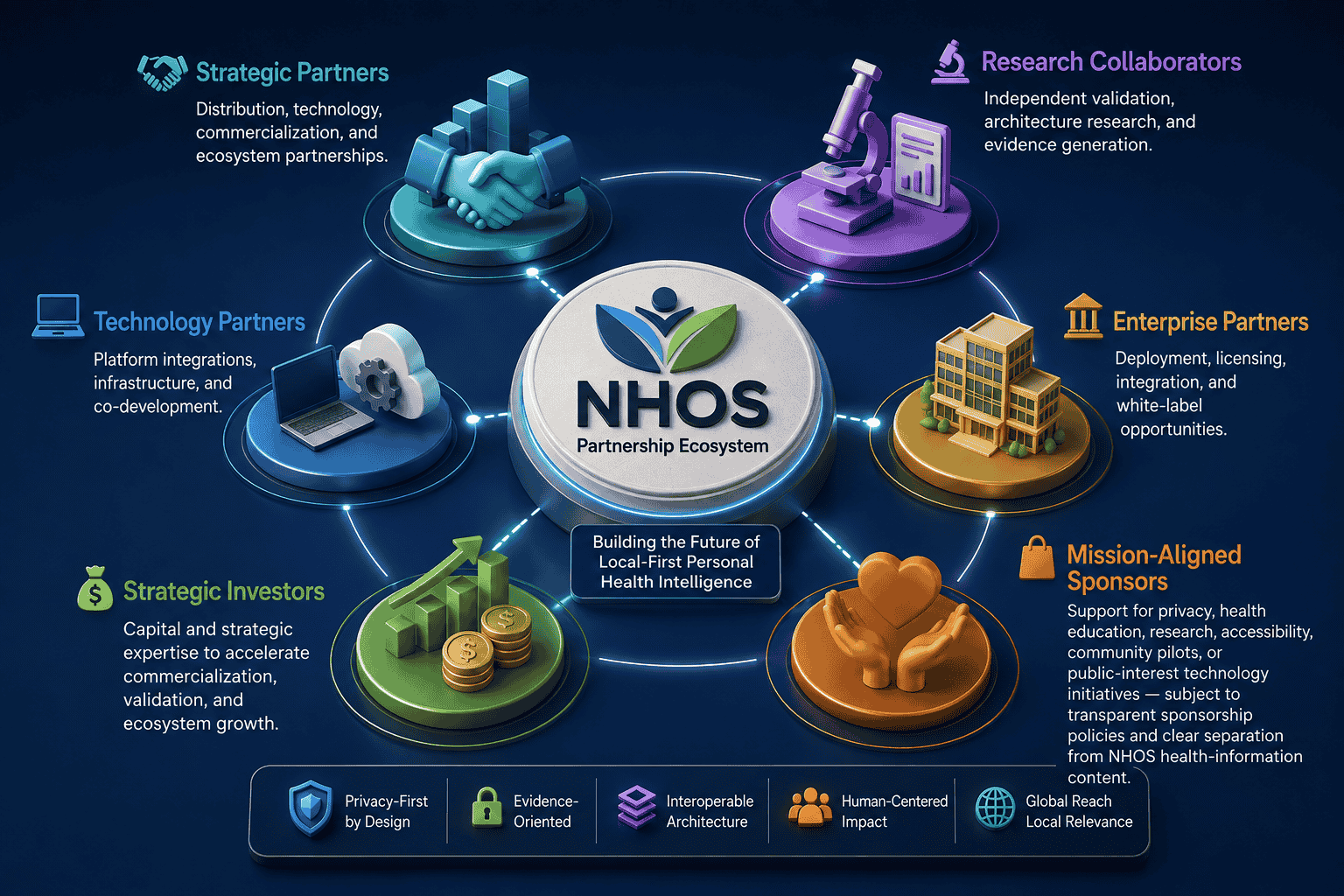
I am open to strategic collaborations with organizations working at the intersection of healthcare, clinical informatics, health intelligence, evidence-based research, privacy-preserving technology, and equitable digital health access. Through NHOS Labs, Inc., the objective is to develop, evaluate, and responsibly extend health-intelligence technologies that respect user autonomy while addressing real-world information and care challenges.
Professional Informatics Affiliation
Adedapo Ogundiran, Founder & Lead Architect of NHOS Labs, Inc., is a member of the American Medical Informatics Association (AMIA).
The affiliation provides an avenue for continued professional engagement with the biomedical and health informatics community and complements the NHOS research program's work in clinical informatics, health information retrieval, knowledge representation, evidence integration, privacy-preserving computing, and digital health systems architecture.
Clinical & Academic Research Partners
- Exploring opportunities for independent research, technical evaluation, validation studies, methodological development, academic collaboration, and responsible real-world assessment of NHOS technologies.
Health Systems & Clinical Organizations
- Exploring applications of health intelligence, analytics, structured knowledge, and privacy-preserving technologies to clinical workflows, patient education, care coordination, and health information access.
Digital Health & Technology Platforms
- Exploring integration opportunities involving health-intelligence architectures, structured health knowledge, local-first technologies, evidence retrieval, and privacy-preserving data capabilities.
Behavioral, Mental & Population Health
- Applying analytics, structured intelligence, behavioral insights, and evidence-informed technologies to problems involving behavioral health, mental wellness, population health, prevention, and health outcomes.
Health Equity & Community Initiatives
- Exploring privacy-preserving and offline-first approaches that can improve access to trustworthy health information for communities facing technological, geographic, socioeconomic, or infrastructure barriers.
Responsible AI & Emerging Health Technologies
- Exploring responsible applications of artificial intelligence and related technologies where they can improve health information access, retrieval, contextualization, analytics, and user experience without compromising privacy, transparency, or appropriate human oversight.
15 References
Available upon request with prior permission from references.
— Professional Healthcare Reference
Dr. Funso Ani
Chief Executive Officer
Meditrust Healthcare
Michael Chen
CEO, HealthTech Innovations
Digital Health Startup Client
Jesse Andrist
Lead Instructor, Data Analysis in Healthcare
ELVTR
Emily King
Program Coordinator, Data Analysis in Healthcare
ELVTR
Additional References Available:
- Behavioral Health Supervisor - A Friendly Face Autism Treatment Services
- Healthcare Management Professor - Fitchburg State University
- Community Health Director - Rotary International
- Data Science Mentor - ELVTR Course Program